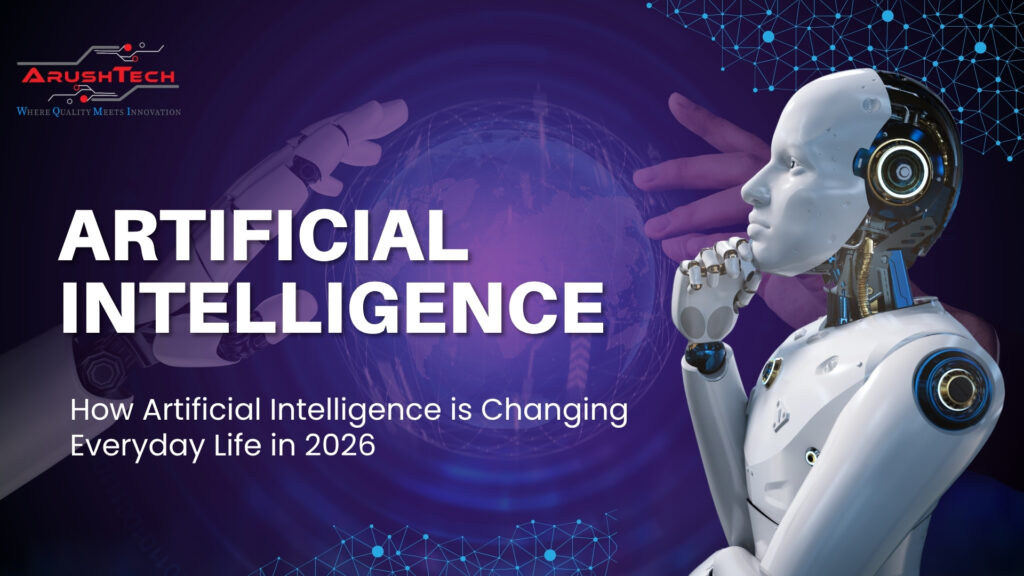
Artificial Intelligence (AI) is no longer a concept limited to science fiction movies or advanced research labs. In 2026, AI has become an essential part of our everyday lives, influencing how we communicate, work, learn, shop, and even think. From smartphones to smart homes, from healthcare to finance, AI is everywhere.
In this article, we will explore how Artificial Intelligence is transforming daily life, its benefits, challenges, and what the future holds.
What is Artificial Intelligence?
Artificial Intelligence refers to the ability of machines or software to perform tasks that typically require human intelligence. These tasks include learning from data, recognizing patterns, making decisions, and even understanding natural language.
AI systems are designed to improve over time through experience. This is why applications like chatbots, recommendation systems, and voice assistants keep getting smarter.
How AI is Used in Everyday Life
1. AI in Smartphones
Your smartphone is one of the most common examples of AI in action. Features like facial recognition, voice assistants, predictive text, and camera enhancements all rely on AI technology.
For example:
- Face unlock uses AI to recognize your face
- Voice assistants answer your questions
- Keyboard suggestions predict what you want to type
These features make smartphones more intelligent and user-friendly.
2. AI in Smart Homes
Smart home devices are becoming increasingly popular. AI allows you to control lights, fans, security cameras, and even kitchen appliances using your voice or smartphone.
Examples include:
- Smart speakers controlling devices
- AI-powered security systems detecting unusual activity
- Automated temperature control systems
AI makes homes more efficient, secure, and comfortable.
3. AI in Healthcare
Healthcare is one of the most important sectors where AI is making a huge impact. AI helps doctors diagnose diseases faster and more accurately.
Key applications include:
- Early detection of diseases like cancer
- AI-powered medical imaging analysis
- Personalized treatment plans
AI also helps in managing patient data and improving hospital operations.
4. AI in Education
AI is revolutionizing the education system by making learning more personalized and accessible.
Some examples:
- Online learning platforms adapting to student performance
- AI tutors helping students understand difficult concepts
- Automated grading systems
Students can now learn at their own pace, making education more effective.
5. AI in Online Shopping
Have you ever noticed how online stores recommend products based on your browsing history? That’s AI working behind the scenes.
AI in e-commerce:
- Recommends products based on your interests
- Provides personalized offers
- Improves customer support through chatbots
This enhances the shopping experience and helps businesses increase sales.
6. AI in Banking and Finance
AI is playing a critical role in the financial sector by improving security and efficiency.
Key uses:
- Fraud detection systems
- Automated customer service
- Smart investment suggestions
Banks are using AI to analyze large amounts of data and make better decisions.
7. AI in Transportation
Transportation is becoming smarter with AI-powered systems.
Examples include:
- Navigation apps suggesting the best routes
- Self-driving car technology
- Traffic management systems
AI helps reduce travel time, fuel consumption, and accidents.
Benefits of Artificial Intelligence
AI offers numerous advantages that improve both personal and professional life.
✔ Increased Efficiency
AI can perform tasks faster than humans, saving time and effort.
✔ Better Decision Making
AI analyzes large amounts of data and provides accurate insights.
✔ Automation of Repetitive Tasks
Routine tasks can be automated, allowing humans to focus on more important work.
✔ Improved User Experience
From personalized recommendations to smart assistants, AI enhances user satisfaction.
Challenges of Artificial Intelligence
Despite its benefits, AI also comes with certain challenges.
⚠ Data Privacy Concerns
AI systems rely on user data, raising concerns about privacy and security.
⚠ Job Displacement
Automation may replace certain jobs, especially repetitive roles.
⚠ Dependence on Technology
Over-reliance on AI can reduce human skills and critical thinking.
⚠ High Development Cost
Building and maintaining AI systems can be expensive.
Future of Artificial Intelligence
The future of AI is extremely promising. As technology continues to evolve, AI will become even more advanced and integrated into our daily lives.
Some future trends include:
- Fully autonomous vehicles
- Advanced robotics in industries
- AI-powered virtual humans
- Smarter cities with automated systems
AI will continue to reshape industries and create new opportunities for innovation and growth.
Why You Should Learn About AI
Understanding AI is no longer optional—it is becoming essential. Whether you are a student, business owner, or professional, learning about AI can provide a competitive advantage.
Benefits of learning AI:
- Better career opportunities
- Improved technical skills
- Ability to adapt to future technologies
Even basic knowledge of AI can help you stay ahead in today’s digital world.
Conclusion
Artificial Intelligence is transforming the world at a rapid pace. From simplifying daily tasks to solving complex problems, AI is playing a crucial role in shaping the future.
As we move forward, embracing AI will not only improve our lives but also open doors to new possibilities. However, it is equally important to use AI responsibly and address its challenges.
If you want to stay updated with the latest trends in technology and AI, keep visiting our website for more informative and engaging content.
Stay connected with ArushTech – Your gateway to future technology!